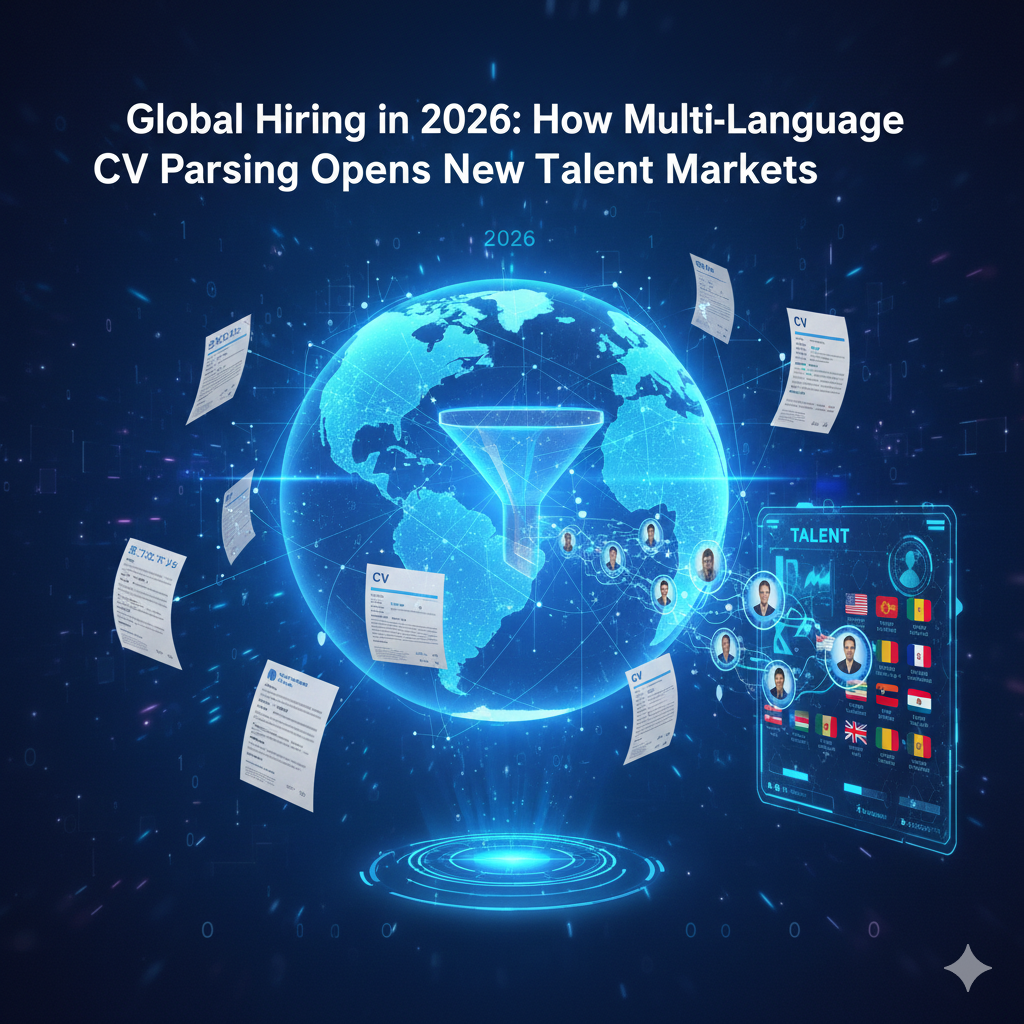
The remote work revolution has fundamentally changed the talent landscape. A 2024 study by Gartner found that 48% of knowledge workers now work remotely at least part-time, and 67% of companies have expanded their hiring to include candidates from other countries. The talent pool has gone global—but most recruiting technology hasn't caught up.
The Language Barrier in Global Recruitment
Consider this scenario: Your company is hiring software developers and receives applications from Brazil, Germany, Japan, and India. Each candidate has submitted their resume in their native language—Portuguese, German, Japanese, and Hindi. Without multi-language capability, you face three poor options:
- Require all candidates to submit English resumes (eliminating potentially excellent candidates who aren't confident in English writing)
- Use generic translation tools that mangle technical terminology and professional context
- Hire translators at significant cost and time delay
Most companies default to the first option, dramatically limiting their talent pool. Research shows that requiring English-only applications reduces your candidate pool by 60-80% in non-English-speaking markets.
How Multi-Language CV Parsing Works
Modern AI-powered CV parsing can process resumes in 80+ languages with the same accuracy as English documents. But it's not just about translation—it's about understanding the conventions and contexts of each market.
Localized understanding: Educational systems, job titles, and professional conventions vary dramatically by country. A "Diplom-Ingenieur" in Germany, "Ingénieur" in France, and "Engineer" in the US represent similar qualifications but are formatted completely differently. Multi-language parsers understand these equivalencies.
Cultural context: In some countries, resumes include photos and personal details; in others, this would be unusual. Some cultures emphasize formal education; others prioritize work experience. Effective parsing accounts for these differences rather than penalizing candidates for following their local norms.
Technical terminology: Generic translation tools often fail on technical terms. A developer's resume might mention "développement full-stack" or "Vollstack-Entwicklung"—the parser needs to recognize these as "full-stack development" and map them to the appropriate skills.
The Competitive Advantage of Global Talent Access
Companies that master global hiring gain significant advantages:
Larger talent pools: Instead of competing with every company in your city for local talent, you're accessing the global workforce. For specialized roles, this can mean the difference between finding qualified candidates or leaving positions unfilled for months.
Cost efficiency: Talent costs vary significantly by geography. A senior developer in San Francisco costs 3-4x more than an equally skilled developer in Eastern Europe or Latin America. Global hiring lets you access world-class talent at competitive rates.
Diversity of perspective: Teams with diverse geographic and cultural backgrounds consistently outperform homogeneous teams on creative problem-solving. They bring different approaches, catch different blind spots, and create products that work for global audiences.
24-hour productivity: With team members across time zones, work can progress around the clock. A bug discovered in the evening in New York can be fixed overnight by a team member in Asia, ready for review the next morning.
Building Your Global Hiring Capability
The technology for global hiring is now mature and accessible. Multi-language CV parsing, combined with AI-powered candidate matching, lets you evaluate candidates from anywhere in the world with the same efficiency as local applicants. The companies that build this capability now will have a lasting advantage in the competition for global talent.