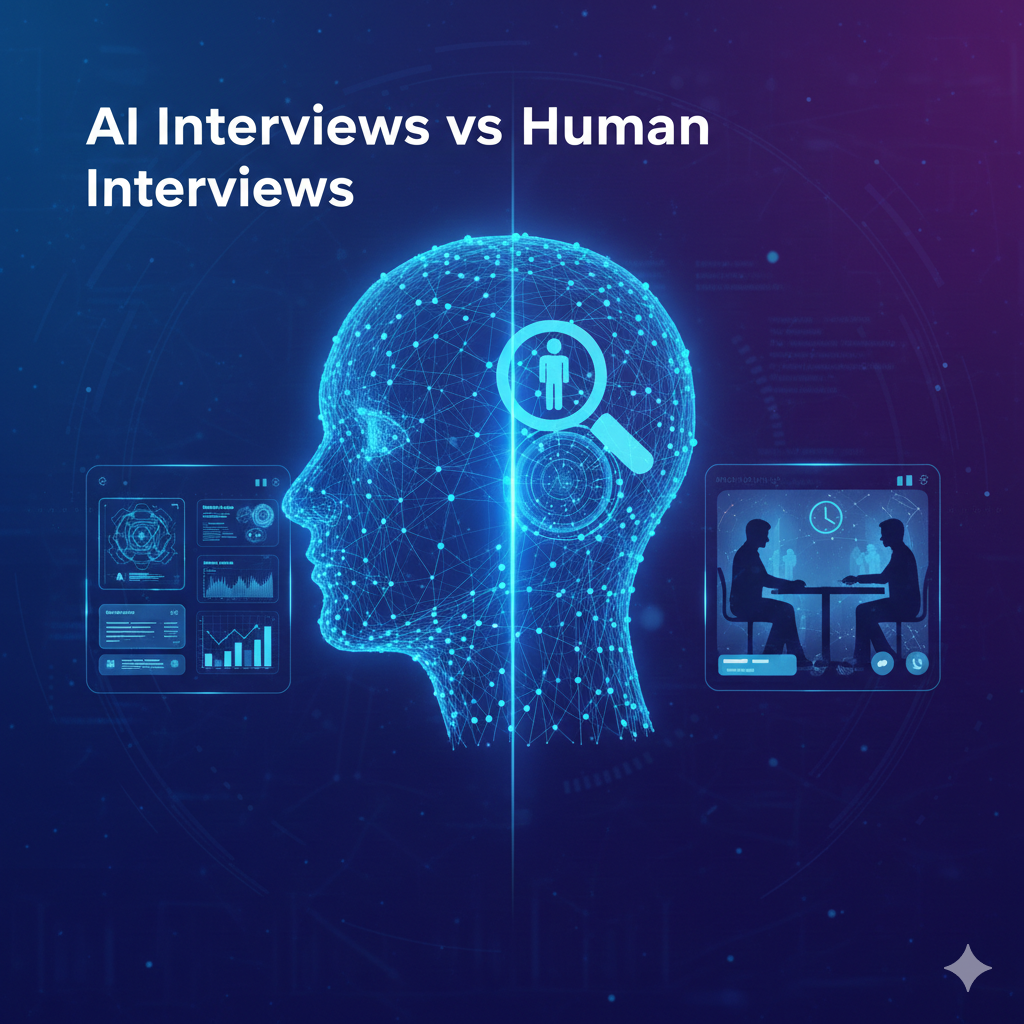
The debate over AI interviews often generates more heat than light. Proponents claim AI eliminates bias and enables 24/7 screening. Critics argue that hiring is fundamentally human and can't be automated. After analyzing data from over 10,000 hiring decisions, we've found that both sides are partially right—and the best results come from understanding when to use each approach.
What AI Interviews Do Better
Consistency at scale: Human interviewers are inconsistent. They're harsher before lunch, more generous on Fridays, and influenced by factors that have nothing to do with candidate quality. In our analysis, the same candidate profile received scores ranging from 3/10 to 8/10 depending on which human interviewer they encountered and when.
AI interviewers ask the same questions, in the same way, with the same evaluation criteria, regardless of time of day or interview number. This consistency is particularly valuable for high-volume hiring where hundreds of candidates need comparable evaluation.
Reduced bias: Our data confirmed what academic research has long suggested: human interviewers exhibit systematic biases based on accent, appearance, name, and demographics. AI interviewers, when properly designed, evaluate only what candidates say—not how they look or sound saying it.
Companies using AI for initial screening saw a 35% increase in diversity among candidates advancing to final rounds, simply by removing unconscious bias from early-stage evaluation.
24/7 availability: Great candidates have busy schedules. AI interviews let them participate at midnight, on weekends, or during lunch breaks—whenever works for them. This flexibility increased completion rates by 40% compared to scheduled human interviews.
What Human Interviews Do Better
Complex judgment: For senior roles requiring nuanced evaluation—leadership potential, cultural contribution, strategic thinking—human interviewers remain superior. These assessments require reading between the lines, asking adaptive follow-up questions, and making connections that current AI cannot.
Selling the opportunity: Interviews aren't just about evaluation—they're also about convincing great candidates to join. Humans excel at building rapport, sharing authentic experiences, and making candidates feel excited about the opportunity. AI can screen; humans can inspire.
Unusual situations: When a candidate has an unconventional background, career gap, or unique circumstance, human interviewers can adapt their evaluation appropriately. AI works best when candidates fit expected patterns; humans handle exceptions better.
The Optimal Hybrid Approach
Our data points to a clear best practice: use AI for initial screening and humans for final evaluation. Specifically:
- Stage 1 (AI): Initial screening for basic qualifications, communication skills, and role-specific knowledge. This filters the candidate pool efficiently and consistently.
- Stage 2 (Human): Hiring manager and team interviews for candidates who pass AI screening. Focus on complex evaluation, cultural fit, and candidate experience.
- Stage 3 (Combined): Final decisions informed by both AI scoring and human judgment, with neither having veto power without review.
Companies using this hybrid approach saw 28% better hiring outcomes (measured by 12-month retention and performance reviews) compared to either all-human or all-AI processes.
The Future of AI Interviews
AI interview technology is advancing rapidly. Today's systems handle structured screening conversations well. Tomorrow's will conduct nuanced discussions, adapt to candidate responses in sophisticated ways, and evaluate soft skills that currently require human perception.
But the fundamental insight from our research will likely remain: the best hiring processes combine AI's consistency and scalability with human judgment and connection. The goal isn't to choose between them—it's to deploy each where it adds the most value.